
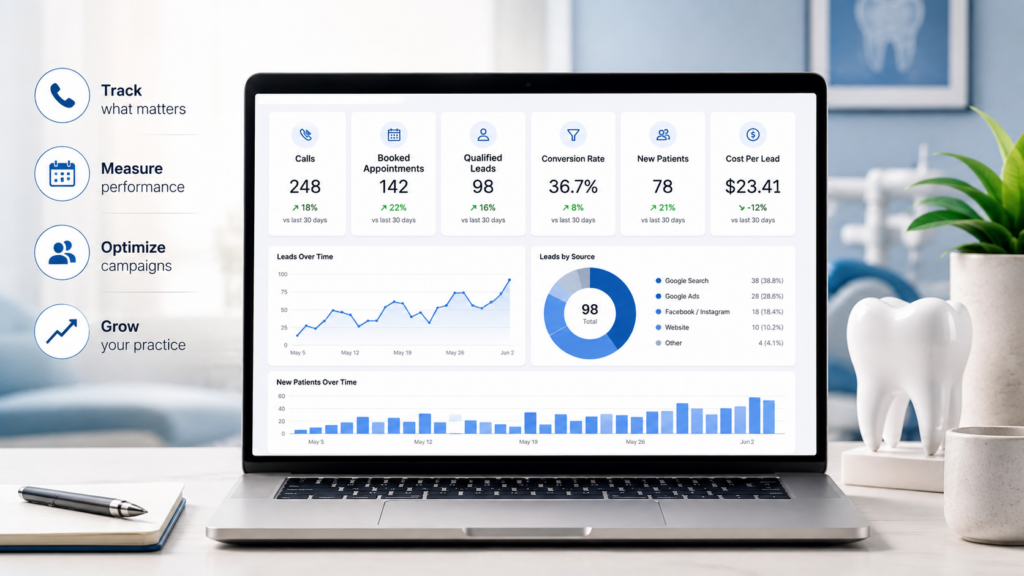
Dental practices have access to more marketing data than ever. Advertising platforms, website analytics, call-tracking systems, and social media accounts can report impressions, clicks, website visits, calls, and form submissions.
The challenge is determining which numbers reflect meaningful campaign performance.
A campaign may generate thousands of impressions without producing qualified patient inquiries or booked appointments. Another campaign may attract less traffic but connect the practice with patients who are a stronger fit and more likely to move forward with care.
The most useful dental marketing metrics connect campaign activity to real practice outcomes. Qualified leads, booked appointments, appointment show rates, completed visits, treatment acceptance, and production provide more business context than clicks or impressions alone.
Activity metrics still matter, but they should help explain performance rather than serve as the final measure of success.
What Is the Campaign Supposed to Achieve?
The right metrics depend on the campaign’s goal.
A campaign promoting emergency appointments should not be evaluated in the same way as one focused on implants, preventive care, or a new practice location. Each may involve a different patient audience, decision timeline, and appointment process.
Common campaign goals include:
- Generating new-patient appointments
- Increasing consultations for a specific service
- Filling available hygiene appointments
- Promoting emergency dental availability
- Supporting a new provider
- Building awareness in a new market
- Reaching patients for a new location
Once the goal is clear, the practice can choose the metrics that show whether the campaign is moving toward it.
A new-patient campaign may focus on booked appointments and completed first visits. An implant campaign may require tracking qualified inquiries, consultation attendance, treatment acceptance, and production over a longer timeframe.
Campaign goals should determine the metrics, not the other way around.
Why Clicks and Impressions Are Not Enough
Impressions, clicks, website traffic, video views, and social engagement help show whether people are seeing and interacting with a campaign.
They can provide useful context:
- Impressions show how often a message is displayed.
- Click-through rate indicates whether the message attracts attention.
- Website traffic shows whether people visit the practice’s site.
- Page engagement may suggest whether the content is relevant.
These numbers do not show whether the campaign reaches the right patients or produces business results.
A practice must still ask:
- Are visitors within the target area?
- Are they looking for a service the practice provides?
- Do they contact the office?
- Do their inquiries become appointments?
- Do those appointments become completed visits or accepted treatment?
Activity metrics are most valuable when they help explain what happens earlier in the conversion process. They should not be presented as proof that a campaign is successful.
Track Qualified Leads and Booked Appointments
Lead volume shows how many people contact the practice through tracked calls, website forms, online chat, or appointment requests. However, not every inquiry is a meaningful opportunity.
A qualified lead generally represents someone who:
- Lives within the practice’s target area
- Is seeking a service the practice provides
- Wants care within a realistic timeframe
- Can be served by an available provider
- Represents a patient inquiry rather than spam, a vendor, or a job applicant
Practices should define a qualified lead consistently. Otherwise, one person may count every call while another counts only patients who schedule.
Qualified leads provide better context than total inquiry volume, but booked appointments show whether those opportunities are moving forward.
Useful measurements include:
- Total qualified leads
- Percentage of leads that qualify
- Percentage of qualified leads that schedule
- Appointments booked by campaign or channel
- Time from inquiry to scheduled appointment
- Cost per lead
- Cost per qualified lead
- Cost per booked appointment
Cost per lead can help compare campaign efficiency, but it does not account for lead quality.
A campaign with a low cost per lead may generate many irrelevant inquiries and few appointments. Another campaign may have a higher cost per lead but attract patients who are more likely to schedule.
Marketing performance should also be reviewed alongside what happens after the inquiry. Missed calls, slow form responses, limited appointment availability, and inconsistent follow-up can prevent qualified leads from becoming patients.
Track Show Rates, Completed Visits, and Treatment Acceptance
A booked appointment does not create value if the patient never arrives.
Appointment show rate connects scheduling activity to completed visits. A low show rate may indicate:
- Appointments scheduled too far in advance
- Weak confirmation or reminder processes
- Patients who were not well matched to the service
- Unclear expectations about the appointment
- Scheduling barriers
- Inconsistent follow-up
Show rates should be reviewed by campaign or service when possible. A patient seeking emergency care may behave differently from someone considering an implant consultation or cosmetic treatment.
Completed visits provide a clearer measure of patient acquisition because they show how many prospective patients contacted the practice, scheduled, and arrived for care.
For service-specific campaigns, treatment acceptance may provide additional context. Practices may review:
- Consultations completed
- Treatment plans presented
- Percentage of patients accepting treatment
- Time from consultation to acceptance
- Common reasons patients do not proceed
- Follow-up after the consultation
Low treatment acceptance does not automatically mean the campaign is attracting the wrong patients. Patient education, financial discussions, consultation quality, scheduling, and follow-up may all influence whether someone moves forward.
Marketing may create an appropriate opportunity, while the patient experience after the inquiry determines whether that opportunity becomes treatment.
Measure Production and Marketing Costs
Production attributed to marketing can help practices understand the financial value connected to completed treatment.
Useful measurements may include:
- Production from completed treatment
- Production by campaign or channel
- Production by promoted service
- Time from the first inquiry to completed treatment
- Campaign cost compared with attributed production
- Production from new patients over a defined period
Production should be interpreted carefully.
Some patients complete treatment shortly after their first visit. Others may require consultations, imaging, financing discussions, or follow-up before deciding. Preventive and general dentistry campaigns may also create value through an ongoing patient relationship rather than one immediate procedure.
Return on marketing investment can provide useful business context, but its reliability depends on the quality of the tracking system.
A patient may see an advertisement, visit the website through search, read reviews, and later call the office directly. Several marketing touchpoints may have influenced the decision.
Practices should avoid treating return on marketing investment as an exact measurement when lead sources, campaign costs, or completed treatment are not recorded consistently.
Follow the Patient Through the Campaign Funnel
A simple campaign funnel can help practice owners see how prospective patients move from initial exposure to completed care:
- Impressions or reach
- Website visits or campaign interactions
- Total inquiries
- Qualified leads
- Booked appointments
- Completed visits
- Accepted treatment
- Completed treatment or attributed production
Not every campaign needs to track every stage. The right funnel depends on the service, campaign goal, available technology, and patient decision process.
The value of the funnel is that it shows where opportunities may be lost.
Strong website traffic with few inquiries may point to a targeting, messaging, or website issue. Many qualified leads with few appointments may indicate slow responses or limited scheduling availability. Consultations that rarely become treatment may suggest problems with case presentation or follow-up.
Effective analytics and reporting should help practices identify these patterns rather than simply display totals.
Track Results Consistently and Over Enough Time
Campaign reports become less reliable when the marketing team, practice leadership, and office staff use different definitions.
Practices should clearly define terms such as:
- Lead
- Qualified lead
- Booked appointment
- Completed visit
- Consultation
- Accepted treatment
- Completed treatment
- Attributed production
A booked appointment should not be counted as a completed visit until the patient attends. A general insurance question may count as an inquiry but may not qualify as a lead for a specific service campaign.
Tracking also requires coordination between call-tracking systems, website forms, chat tools, scheduling systems, practice management software, and team members recording lead sources.
Perfect attribution may not always be possible, but consistent tracking allows practices to compare results more reliably over time.
Campaigns should also be evaluated over an appropriate timeframe.
Emergency and general dentistry campaigns may generate results relatively quickly. Patients considering implants, cosmetic dentistry, or orthodontic treatment may spend more time researching, attending consultations, evaluating financial options, and deciding whether to proceed.
One unusually strong week or one large treatment case does not necessarily establish a reliable trend. Practices should monitor campaigns regularly while allowing enough time to collect meaningful data before making major decisions.
Use the Data to Improve the Campaign
Marketing measurement is useful only when it leads to better decisions.
Depending on the results, a practice may need to:
- Refine campaign targeting
- Adjust the message
- Improve a landing page
- Change the service being promoted
- Improve call handling
- Add appointment availability
- Strengthen patient follow-up
- Shift spending between channels
- Pause an ineffective campaign
- Continue a campaign producing qualified outcomes
The action should match the problem shown by the data.
Low click-through rates require different changes than low booking rates. Poor lead quality may require targeting or messaging adjustments. A high no-show rate may point to scheduling, reminders, or patient communication.
Clear To Launch’s marketing services connect campaign planning, execution, and measurement so performance can be reviewed within the broader context of practice goals and operations.
Measure the Results That Matter to the Practice
No single dental marketing metric provides a complete view of campaign effectiveness.
Impressions, clicks, and website traffic help explain how people interact with marketing. Qualified leads and booked appointments show whether campaigns are creating meaningful opportunities. Show rates, completed visits, treatment acceptance, and production reveal what happens after those opportunities reach the practice.
The strongest measurement approach connects each stage.
This article complements the broader discussion of leveraging data analytics to boost dental practice growth. Practice-wide analytics can support long-term decisions, while campaign-specific metrics help determine whether individual marketing efforts are producing their intended outcomes.
Clear To Launch helps dental and healthcare practices establish measurement systems that connect marketing activity to qualified leads, appointments, treatment outcomes, and production.
Practices seeking a clearer view of campaign performance can contact Clear To Launch to discuss analytics and reporting aligned with their goals.
Frequently Asked Questions
What is the most important dental marketing metric?
There is no single most important metric for every campaign. The best measurement depends on the campaign goal. Qualified leads, booked appointments, completed visits, treatment acceptance, and production generally provide more business context than impressions or clicks alone.
Is cost per lead enough to evaluate a dental campaign?
No. Cost per lead shows how efficiently a campaign generates inquiries, but it does not show whether those leads are qualified, book appointments, attend visits, or accept treatment.
Can a campaign be effective if it generates fewer leads?
Yes. A campaign producing fewer but more qualified leads may result in more booked appointments, completed visits, or accepted treatment than one with higher overall lead volume.