
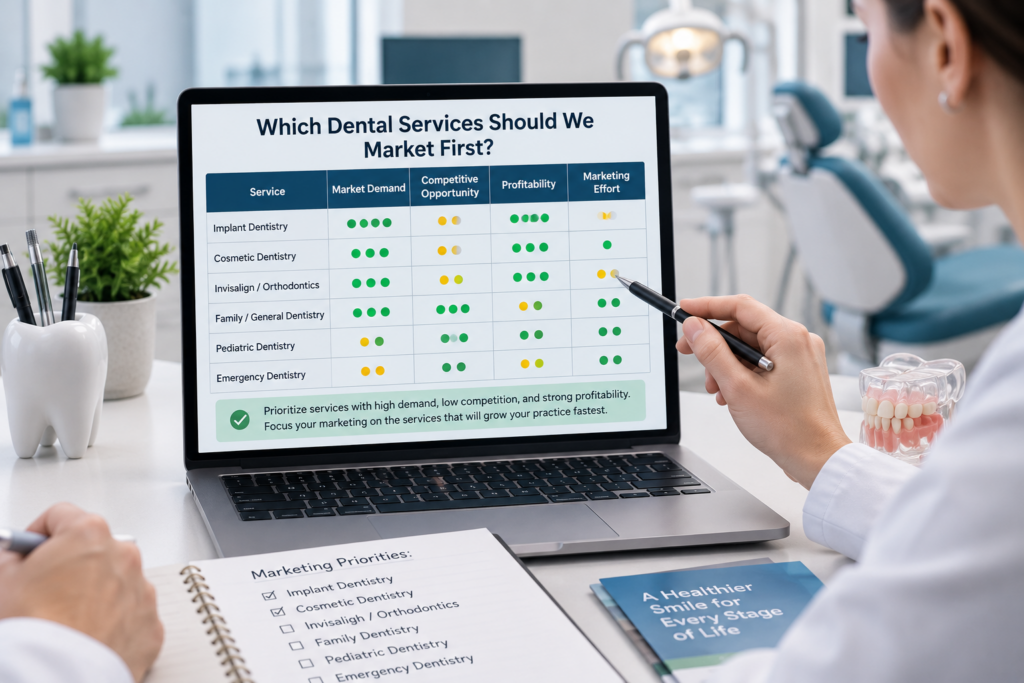
Dental practices often have several services they would like to grow. A general practice may want more implant consultations, cosmetic cases, clear aligner patients, emergency appointments, and new-patient exams at the same time.
Giving every service equal marketing attention, however, can spread resources too thin and make campaigns harder to evaluate. Different services attract different patients, require different workflows, and place different demands on the schedule and team.
A dental service marketing strategy helps a practice determine which services deserve priority based on patient demand, business goals, appointment capacity, competition, operational readiness, and sustainable financial value.
The goal is not to identify one service that every dental office should promote. It is to create a practical framework for selecting the opportunities that best fit the practice’s current position and long-term direction.
What Does Service Prioritization Mean?
Service prioritization means deciding which treatments or appointment types should receive the greatest marketing focus during a defined period.
A practice can continue listing all its services on its website while giving additional marketing support to one or two priorities through:
- Dedicated website content
- Search engine optimization
- Paid advertising
- Email or social media campaigns
- Video and photography
- Patient education
- Referral initiatives
For example, a practice may provide general dentistry, implants, clear aligners, cosmetic care, and emergency services. Instead of launching separate campaigns for all five, it may initially focus on the services that best align with current patient demand, available appointments, and practice goals.
Priorities can change as capacity, staffing, market conditions, or business objectives change.
Start With the Practice’s Growth Goals
Before comparing individual services, the practice should define what it wants marketing to accomplish.
Possible goals may include:
- Increasing new-patient appointments
- Filling unused clinical capacity
- Building a particular area of care
- Supporting a new associate
- Increasing recurring preventive visits
- Expanding into a new market
- Preparing for another location
- Reaching a different patient population
The right service depends partly on the goal.
A practice seeking more recurring patients may prioritize new-patient exams and preventive care. An office with an experienced implant provider and available treatment capacity may focus on implant consultations. A practice with scheduling flexibility may consider emergency dentistry as a way to serve immediate needs and potentially establish longer-term patient relationships.
Without a clear objective, practices may select services based on treatment fees, personal preference, or assumptions rather than strategic value.
Compare Patient Demand and Market Opportunity
Patient demand is an important factor, but it should be evaluated using more than one source.
Internal information may include:
- Services patients frequently ask about
- Appointment types with growing demand
- Website visits and form submissions by service
- Accepted and declined treatment plans
- Patient referrals
- Common consultation questions
- Services patients are referred elsewhere to receive
External market research can provide additional context through local demographics, population changes, search behavior, competitor offerings, and service availability.
Competition should also be considered carefully. Strong competition may indicate meaningful demand, but it may require clearer positioning or stronger patient education. Limited competition may signal an opportunity, but it may also reflect low demand or operational barriers.
Practices should ask:
- How many nearby offices promote the service?
- Does the local population appear to support additional demand?
- Are there underserved patient groups or geographic areas?
- Can the practice communicate a genuine and supportable difference?
- Are current inquiries coming from patients who are likely to schedule and proceed with care?
Demand should be considered alongside practice capacity and business value. High search activity or frequent questions do not automatically make a service the right priority.
Confirm Capacity and Operational Readiness
Marketing should not generate more demand than the practice can manage effectively.
Before prioritizing a service, practice owners and office managers should evaluate whether the team can accommodate additional inquiries, consultations, and treatment.
Relevant considerations include:
- Provider availability
- Consultation capacity
- Treatment room availability
- Procedure length
- Assistant or hygiene support
- Equipment and technology
- Laboratory coordination
- Scheduling lead times
- Patient education
- Financial discussions
- Follow-up responsibilities
A campaign may generate implant inquiries, but its value will be limited if consultations cannot be scheduled promptly or prospective patients do not receive consistent follow-up. Emergency dental marketing may create frustration if the practice cannot offer timely evaluations.
Clinical readiness also matters. Marketing should reinforce services the practice can provide confidently and consistently. The team should understand how to answer common questions, explain the next step, and guide prospective patients through the scheduling process.
A service is a stronger marketing candidate when the practice has the clinical capability, team support, appointment capacity, and communication systems required to provide a consistent patient experience.
Review Case Acceptance and Follow-Up
Marketing can create inquiries, but it cannot control what happens after a prospective patient contacts the practice.
Before increasing promotion for a service, review how effectively current interest becomes scheduled and accepted treatment.
Useful indicators may include:
- Inquiry-to-appointment rate
- Consultation attendance
- Treatment acceptance
- Time between inquiry and appointment
- Follow-up completion
- Common reasons patients do not proceed
- Financing questions or barriers
- Team confidence discussing the service
If many patients inquire but few schedule or accept treatment, additional marketing may increase the volume of an existing problem.
The practice may first need to improve call handling, consultation workflows, patient education, financial conversations, or follow-up. Strengthening these systems can create a better foundation for future promotion.
Evaluate Financial and Long-Term Value
Revenue potential is a reasonable consideration, but treatment fees alone do not show the full business value of a service.
Practices should also evaluate:
- Provider and team time
- Laboratory and material expenses
- Equipment costs
- Consultation and marketing expenses
- Treatment acceptance
- Cancellation and no-show rates
- Follow-up requirements
- Opportunity costs within the schedule
- Potential for ongoing patient relationships
A high-fee service may produce less value than expected if consultations rarely lead to treatment or procedures require substantial resources. A lower-fee service may contribute more consistently when demand is strong, scheduling is efficient, and patients return for ongoing care.
The strongest priority is not necessarily the most expensive treatment. It is the service that offers a sustainable balance of demand, profitability, capacity, patient fit, and long-term value.
Use a Service-Prioritization Scorecard
A scorecard can help practice leaders compare services using consistent criteria instead of personal preference.
Each service can be rated as low, moderate, or high across categories such as:
| Evaluation Factor | Questions to Consider |
| Practice goal alignment | Does this service support the practice’s current growth objective? |
| Patient demand | Are current or prospective patients actively seeking it? |
| Market opportunity | Do demographics and competition suggest a viable opportunity? |
| Appointment capacity | Can consultations and treatment be scheduled within a reasonable time? |
| Provider readiness | Does the provider have the experience and confidence to support growth? |
| Team readiness | Can the team answer questions, schedule patients, and follow up consistently? |
| Profitability | Does the service provide sustainable value after expenses and time are considered? |
| Case acceptance | Are current consultations leading to accepted treatment? |
| Long-term patient value | Could the service support broader or ongoing patient relationships? |
Some categories may carry more weight depending on the practice’s circumstances.
Appointment capacity may matter most when the schedule is already busy. Market opportunity may receive greater weight when entering a new area. Case acceptance and follow-up may be especially important for complex or higher-consideration treatments.
The scorecard is not intended to produce a perfect answer. It creates a more structured and transparent decision-making process.
Select One or Two Priorities
After comparing the available opportunities, many practices may benefit from selecting one or two initial priorities rather than creating campaigns for every service.
A focused approach allows the practice to:
- Develop clearer messaging
- Build more relevant website content
- Train the team around expected inquiries
- Measure appointments and treatment outcomes more accurately
- Identify workflow problems sooner
- Adjust the strategy before expanding it
The selected services should also fit together logically.
A practice may prioritize emergency dentistry and new-patient care because immediate appointments can introduce patients to the broader practice. Another office may pair implant consultations with related restorative care when both align with its capabilities and patient base.
Prioritization does not mean ignoring every other service. It means giving the strongest current opportunities enough attention to evaluate them properly.
Measure Results and Adjust Priorities
Before launching a campaign, decide how success will be measured.
Traffic, impressions, clicks, and form submissions provide useful context, but they do not show the full business result. Practices should connect marketing activity to outcomes such as:
- Qualified inquiries
- Scheduled consultations
- Appointment show rates
- Treatment acceptance
- Completed treatment
- Production associated with the service
- Cost per qualified inquiry
- Cost per scheduled appointment
- Follow-up time
- Use of available treatment capacity
The most appropriate measures will depend on the service.
Emergency dentistry may be evaluated by whether qualified callers receive timely appointments. Implant marketing may require tracking consultations, treatment acceptance, and completed cases over a longer timeframe. Preventive care campaigns may focus on new-patient appointments and whether those patients continue with ongoing care.
Clear analytics and reporting can help determine whether marketing is producing meaningful business opportunities rather than activity alone.
Priorities should also be reviewed whenever capacity, staffing, competition, services, or business goals change. A successful campaign may need to be reduced after available appointments are filled. Another service may become a stronger opportunity after the practice adds a provider, equipment, or new team capabilities.
Build Campaigns Around the Right Opportunities
The service with the highest treatment fee is not always the best one to market first.
The strongest priority is usually the service that aligns with patient demand, local opportunity, practice goals, appointment capacity, clinical strengths, team readiness, and sustainable business value.
By evaluating these factors before campaign planning, dental practices can avoid spreading resources across too many services or generating inquiries they are not prepared to manage. They can instead create focused campaigns, measure meaningful outcomes, and adjust their priorities as conditions change.
This decision should also be considered alongside broader planning before increasing your dental marketing budget. Choosing what to promote and deciding how much to invest are related decisions, but they are not the same.
Clear To Launch helps dental practices connect service priorities with market intelligence, operational realities, and a focused dental marketing strategy.
Practices that need help determining which opportunities deserve attention first can contact Clear To Launch to discuss a strategy aligned with their goals and capacity.
Frequently Asked Questions
Should dental practices market their most profitable service first?
Not automatically. Profitability matters, but practices should also consider demand, competition, appointment capacity, case acceptance, team readiness, and alignment with broader business goals.
How many services should a dental practice market at one time?
The appropriate number depends on the practice’s resources, capacity, and ability to track results. Many practices may benefit from starting with one or two priorities before adding more campaigns.
How can a practice measure demand for a service?
Practices can review inquiries, appointment requests, website activity, treatment discussions, referrals, market research, and competitor offerings. No single source should determine the decision by itself.
What should a practice do if marketing generates more demand than it can handle?
The practice may need to reduce or pause the campaign, adjust targeting, increase scheduling capacity, improve workflows, or shift attention to another service. Continuing to generate inquiries without the ability to respond may weaken the patient experience.
Can marketing fix low case acceptance?
Marketing may generate more inquiries, but it does not correct problems with consultations, patient education, financial discussions, or follow-up. Practices should strengthen those processes before significantly increasing promotion.