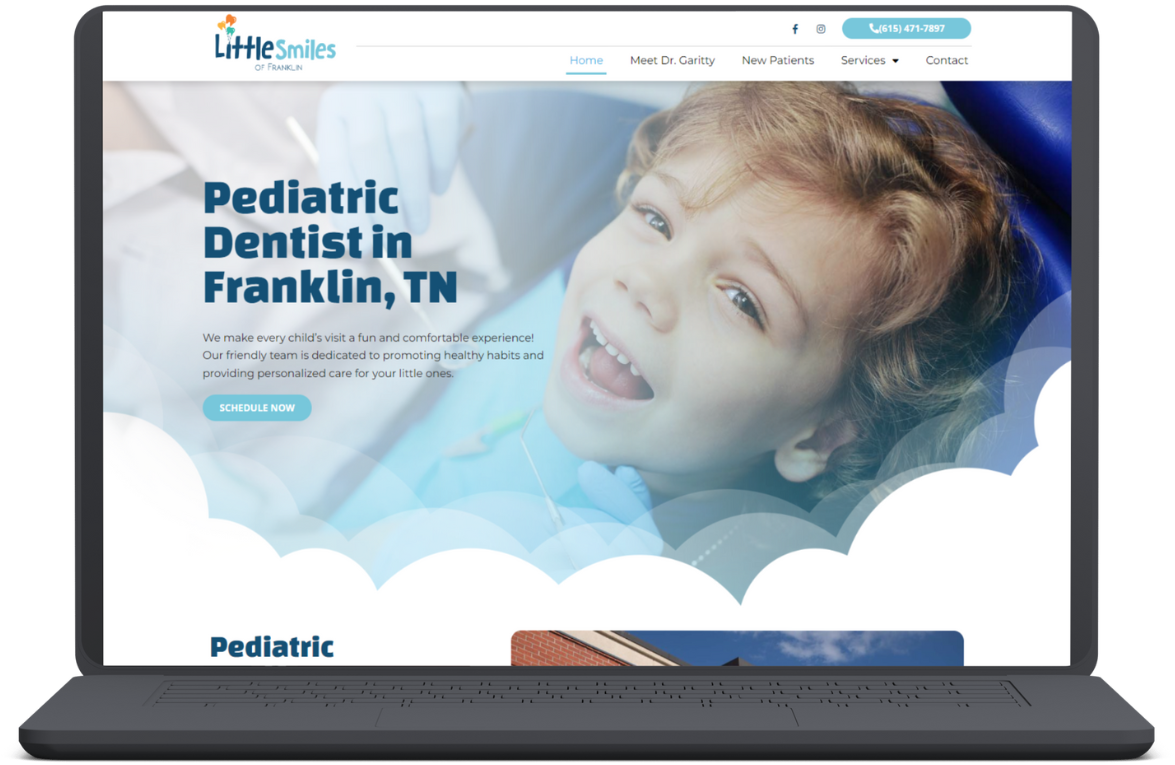

When someone searches for a dentist, emergency dentist, dental implants, orthodontist, or another dental service nearby, Google has to determine which practices are most relevant to that person and location. Your Google Business Profile plays an important role in that decision, but local SEO is much bigger than one listing.
Your website, service pages, reviews, business information across the web, local content, links, internal site structure, and overall authority all help create a clearer picture of who your practice serves and where it operates. When those signals reinforce one another, prospective patients are more likely to find accurate information about your practice and understand why it may be relevant to their needs.
For most dental practices, we prioritize the foundation first: accurate business information, a strong website and service structure, a properly managed Google Business Profile, and a consistent review strategy. Local content, citations, links, and broader authority then build on that foundation.
The strongest local SEO programs make those pieces work together instead of treating each one as a separate task.
What Does Local SEO Mean for a Dental Practice?
Local SEO is the process of improving a practice’s visibility for searches connected to a geographic area. That can include obvious searches such as “dentist in St. Louis” or “emergency dentist near me,” but it also includes searches where Google already understands the person’s location and determines that local results are appropriate.
Google says its local results are primarily influenced by relevance, distance, and prominence. Relevance reflects how well a business matches the search. Distance considers where the business is in relation to the person searching, while prominence reflects how established or well-known the business appears to be.
A dental practice cannot control every part of that equation. You cannot optimize your way around being 20 miles from someone searching for a dentist two blocks from their home. What you can control is how clearly Google understands what your practice does, where it operates, which services it provides, and whether the business appears to be a credible local result.
That requires a connected strategy rather than one ranking trick.
Start With a Website That Clearly Represents the Practice
One of the most common local SEO problems we see is a disconnect between a practice’s Google presence and its website. The Google Business Profile may contain the correct address, categories, reviews, and photos, while the website barely explains the services offered or where the practice is located.
Your website should reinforce the same real-world business patients see elsewhere. A visitor should be able to determine where the office is, who practices there, what treatments are offered, how to contact the team, and what makes the practice relevant to someone in that market.
For a single-location practice, that does not mean stuffing the city name into every heading. It means using local context where it naturally helps. A dental implant page might appropriately explain that the practice provides dental implants in its city. A doctor biography should make clear where that dentist practices. Contact pages can include useful directions, parking information, nearby landmarks, or surrounding communities when those details genuinely help patients.
We still encounter dental websites where older SEO tactics have pushed the city name into headings, body copy, metadata, and image alt text so often that the content stops sounding natural. Local optimization should make the website clearer and more useful, not make every paragraph sound as if it was written for a search engine.
Our guide to building dental websites for Google and for people goes deeper into that balance between search visibility and patient experience.
Google Business Profile Supports the Strategy, but It Is Not the Strategy
A well-managed Google Business Profile is one of the most visible components of local dental SEO. It can show your office location, hours, phone number, reviews, photos, services, website, directions, and appointment options before someone ever visits your website.
Because GBP is so visible, it often becomes the entire focus of a local SEO conversation. That is a mistake. A strong profile connected to a weak website, outdated business information, poor reviews, or thin location content still leaves major gaps in the local search ecosystem.
We treat GBP as one part of a larger system. The categories and services should accurately reflect the practice, the website link should lead somewhere useful, hours should stay current, photos should represent the real office, and profile information should align with the business patients encounter elsewhere.
For the deeper profile-level strategy, including categories, services, verification, photos, reviews, and ongoing management, see our complete guide to Google Business Profile for dentists.
Reviews Are Both a Reputation Asset and a Local Search Signal
Reviews influence more than a star rating. Google specifically identifies review quantity and positive ratings as factors that can contribute to local prominence, while patients use reviews to judge whether a practice feels trustworthy, professional, and appropriate for their needs.
For dental practices, the strongest review strategies are ongoing rather than campaign-based. A practice that collects a burst of reviews and then receives almost none for a year presents a different picture from one that consistently receives current patient feedback.
The reviews themselves also tell prospective patients things that a practice website cannot say as credibly on its own. Patients may comment on communication, comfort, emergency care, scheduling, treatment experiences, the team, or how they felt during a visit. Those details help shape the reputation of the individual office.
We also look beyond the overall rating. One location in a dental group may have hundreds of recent reviews while another has very little activity. A practice may have a strong rating but recurring comments about scheduling or communication. Local reputation management should be able to identify those differences instead of looking only at one aggregate number.
Review responses deserve particular care in healthcare. Teams can acknowledge feedback warmly and professionally without confirming private treatment information simply because a reviewer chose to discuss it publicly.
Keep Business Information and Local Citations Accurate
Google builds its understanding of local businesses from more than information entered directly into a Business Profile. Its documentation notes that business information can also come from publicly available web content, licensed third-party data, user contributions, and other sources.
That makes accuracy across important online properties valuable. A dental practice may update its website and Google Business Profile after a move but leave an old address on professional profiles, social platforms, business directories, insurance-related resources, or community websites. Rebrands, acquisitions, new phone systems, and provider changes can create similar inconsistencies over time.
Local citations are part of that broader business-information ecosystem. These are online references to the practice, often including its name, address, phone number, or website. Relevant citations may come from reputable business directories, professional organizations, chambers of commerce, healthcare resources, local associations, or other legitimate websites.
We do not view citation building as a contest to create the largest number of listings possible. For established dental practices, the more valuable work is often correcting inaccurate information, resolving duplicates, maintaining important listings, and making sure legitimate sources accurately reflect the business.
Accuracy matters more than chasing hundreds of obscure directories.
Use Local Keywords and Content Without Making the Website Sound Artificial
Local relevance should be visible in website content, but there is a major difference between meaningful localization and inserting city names everywhere.
Keyword research can help identify how patients describe services and combine them with local intent. A practice may discover meaningful demand around searches such as “emergency dentist in [city],” “Invisalign near me,” or “dental implants in [market].” Those insights can inform service pages, metadata, headings, location pages, and supporting content when the search intent matches what the practice actually offers.
Our dental keyword guide explains how to evaluate those search terms in greater depth.
The mistake is assuming every keyword needs its own page or every nearby community needs a nearly identical landing page. We still see websites containing multiple city pages where almost nothing changes except the city name. That creates content volume without necessarily adding local value.
Useful local content should tell the reader something meaningful. A location page might explain the office, its providers, major services, directions, parking, and surrounding communities. A new practice may need content establishing its connection to a market. A multi-location group may need to clarify which services are offered at which locations.
The local element should add information rather than simply add a keyword.
Earn Local Authority Through Real Relationships
Links remain part of Google’s broader understanding of prominence, and local backlinks can reinforce the connection between a dental practice and its community. For dentists, the strongest local links tend to come from real-world relationships rather than manufactured SEO tactics.
A practice may earn relevant links through professional associations, community organizations, sponsorships, charities, schools, local events, business groups, partnerships, or media coverage. A dentist who contributes expertise to a local news story may earn a meaningful link, while a practice sponsoring an established community event may be included on the organization’s website.
Not every community activity needs to become a link-building campaign, and not every backlink carries the same value. We would rather see a dental practice earn a handful of credible local or professional links than build dozens of low-quality listings simply because an SEO tool reports a larger total.
Local authority should reflect what it actually is: a real business participating in a real community.
Plan Internal Links as Part of the Local SEO Structure
Not every local SEO signal comes from outside the website. Internal links help patients and search engines understand how important pages relate to one another.
A location page can link naturally to the major treatments actually offered at that office. If a location provides dental implants, emergency dentistry, and Invisalign, those services should be easy to reach from the location content rather than buried elsewhere on the site. A dental implant article can lead to the primary implant service page, while a doctor biography can connect with the services that provider performs.
We frequently find dental websites that have created the right pages but left them operating like islands. Important treatment pages may receive very few contextual links, while a handful of featured services are linked repeatedly from almost every part of the site.
Good internal linking is selective. The goal is not to insert a link every few paragraphs but to create logical pathways through the website so patients and search engines can understand which pages matter and how they fit together.
This becomes even more important as the site grows. Blogs, service pages, provider profiles, location pages, and educational resources are much easier to manage when internal linking is considered as part of the content architecture rather than an afterthought.
Think About Map Visibility Across the Market, Not From One Search
Dental practices understandably want to know how to rank higher in Google Maps, but local visibility can change depending on both the business and where the person searching is located. Checking a ranking from one computer at the dental office can therefore create a misleading picture because a practice may appear extremely visible from the front desk while performing very differently several miles away.
Grid-based local rank tracking can provide a more useful view because it shows how visibility changes across the surrounding market. The value is not the grid itself. It is the question the grid can help answer: Are we visible only immediately around the office, or are we building meaningful coverage across the geographic area from which the practice realistically wants to attract patients?
Even then, local rankings are an indicator rather than the final outcome. Visibility matters because it can create more opportunities for the right prospective patients to discover the practice.
Multi-Location Dental SEO Requires More Structure
Managing local SEO for one dental office is different from managing it across five, 20, or 100 locations.
Every practice needs enough unique information for patients and search engines to understand that individual office, including its address, providers, services, hours, reviews, photos, and other meaningful differences. At the same time, the larger organization needs standards for website structure, GBP ownership, reputation management, tracking, content, and brand consistency.
One of the most common multi-location mistakes is creating nearly identical location pages with little more than the city changed. Another is failing to explain which treatments are actually available at which practice. We also see groups link every Google Business Profile to the same generic homepage even when useful location pages exist.
Nearby offices can create another challenge. Their local markets may legitimately overlap, but SEO and paid media efforts should be coordinated so the organization understands when its own locations are pursuing the same searches or audiences.
For a deeper look at scaling across multiple offices, see our guide to multi-location dental marketing.
Local SEO Still Has to Convert the Patient
A practice can improve visibility and still lose the patient after the click.
Someone who discovers your office in Google Maps may visit the website, read reviews, view photos, research a dentist, compare treatments, look for financing information, or check whether the office accepts new patients before deciding to call.
If the website is difficult to use on mobile, the phone number is hard to find, the GBP and website disagree about hours, or a treatment page gives the patient little useful information, the local SEO strategy has only completed half the job.
This is why we do not separate search visibility entirely from website experience. Local SEO creates the opportunity to be discovered, but the website, reputation, and patient journey influence what happens next.
A strong local strategy should make it easier for the right person to move from a search result to useful information and eventually to an appointment.
Measure Local SEO by Business Impact, Not Just Rankings
Rankings matter because they help us understand whether a practice is becoming more visible for important searches and across meaningful geographic areas. Google Business Profile interactions, organic traffic, and Search Console performance can provide additional context, but those metrics are still indicators.
Booked patients and completed visits are business outcomes.
For a dental practice, the metrics become more meaningful as they move closer to patient acquisition: qualified phone calls, forms, appointment requests, booked patients, completed visits, and treatment opportunities when the available systems allow those outcomes to be tracked.
If rankings improve but qualified inquiries do not, that should lead to another question rather than an automatic conclusion that SEO is succeeding. The wrong keywords may be improving. The site may not convert effectively. The location may lack schedule capacity. Calls may be going unanswered, or prospects may be contacting the practice for services it does not actually want to grow.
Good reporting helps diagnose those relationships.
Our guide to dental marketing metrics explains why traffic, impressions, and rankings become much more useful when they can be connected to leads, appointments, and actual practice outcomes.
The Most Common Dental Local SEO Problem Is Disconnection
Many local SEO problems are not advanced technical issues. They are disconnects that accumulate as a practice changes.
We see practices with hundreds of excellent Google reviews but thin service pages. We see strong websites attached to incomplete Google Business Profiles. A dentist moves, but the old address remains online. A provider leaves, yet continues appearing across the website months later. A multi-location group may have one office receiving strong local support while another barely appears outside searches for its own name.
Other practices have created too much rather than too little. Every nearby city has its own nearly identical page. Slight keyword variations have become separate URLs. Blog posts compete with the main service pages they were supposed to support.
Local SEO often requires both expansion and cleanup. Sometimes the practice needs stronger content or greater local authority. Other times, the better recommendation is consolidating duplication, correcting outdated information, improving internal links, or strengthening assets that already exist.
That is why local SEO should be managed as a system rather than a collection of isolated tasks.
Local SEO Works When the Pieces Reinforce One Another
Your website tells patients and search engines what the practice offers and where it operates. Google Business Profile makes essential information highly visible in Search and Maps. Reviews provide reputation and patient experience signals. Accurate business information reinforces the real-world practice, while local content and links help establish relevance and authority within the market.
Internal links organize those website resources, and measurement tells the team whether improved visibility is turning into meaningful patient activity.
If a practice is optimizing its Google Business Profile, publishing content, collecting reviews, and tracking rankings but those efforts are not working together, the issue may not be effort. It may be structure.
Build Local Visibility Around the Patients You Want to Reach
Clear to Launch Healthcare Marketing works with general dentists, specialists, startups, established practices, multi-location groups, and DSOs across the country. We evaluate local SEO as a connected system that includes the website, service and location architecture, Google Business Profiles, reviews, local authority, content, internal linking, technical foundations, visibility, and the patient actions those efforts generate.
The priorities are not identical for every practice because the markets are not identical. A new startup may need to establish local relevance and reputation from the ground up, while an established practice may need to clean up years of outdated listings, thin content, or overlapping pages. A multi-location group may need an entirely different level of governance.
The goal is not simply to appear for more searches. It is to become more visible to the right prospective patients and give those patients a clear path from finding the practice to choosing it.
Learn more about our healthcare SEO services or contact Clear to Launch Healthcare Marketing to discuss your practice’s local search strategy.